


A Radiohead Pilgrimage: This Is What I Got

By elly in ISSUE 001 - TODAY IS THE DAY
· 115 views
In late November 2025, I found myself in Italy with a couple of days to spare. I had never been to Rome before, so had booked myself in for a few recommended tours. I did not expect my luggage to miss the plane. Thankfully it arrived a day later to my hotel, though this did mean visiting the Sistine Chapel, staring up at Michelangelo, whilst wearing my brightly coloured Radiohead tour sweater. Which does feature a large horned minotaur that looks a lot like the devil. Luckily the Catholics were not offended.
Apparently it is a Jubilee year, and every 25 years a Holy Door opens at the Vatican. Pilgrims come from all over the world to pass through it. Staring up at The Creation of Adam in my burgundy and orange sweater, I reflected that we Radiohead fans were undergoing our own sort of pilgrimage. It has been seven long years since Radiohead last opened their gates, and we have come from far and wide.
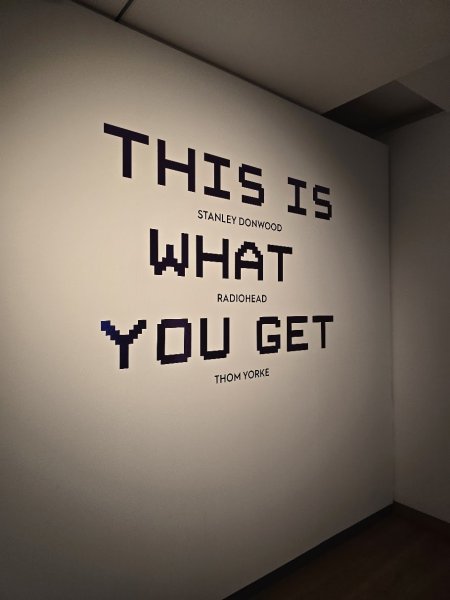
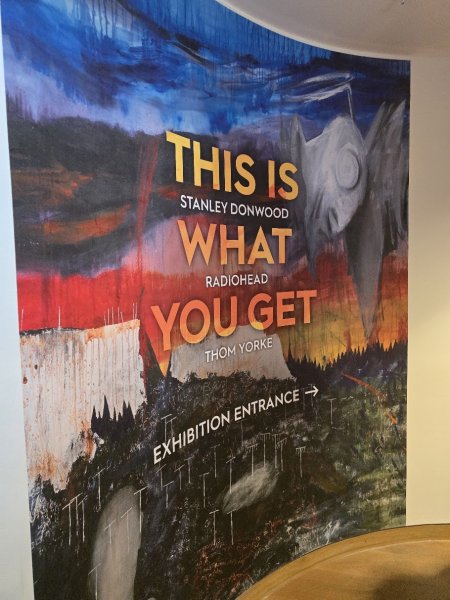
A short time later, my friend and I were on our way to Oxford, the small English town where it all began, to see This Is What You Get, a retrospective on Thom Yorke and Stanley Donwood’s long creative partnership. Oxford is, on the surface, a university town with its own rhythms and quirks. For Radiohead fans, though, it’s the place where the music first took shape.
---
We took the train from Paddington in the morning, and watched the countryside evolve into a landscape that as a child I assumed had been made up. It’s just so… ordered. Green, rolling away into the foggy horizon like an unfinished painting. Surely this was invented for the dense Victorian novels I was made to read in school? For an Australian used to a forty-degree summer and a landscape that is usually on fire or underwater, the soft English countryside feels reassuringly gentle, though I’m still mystified by the way it all seems permanently wet.
I’m about to see an art exhibition shaped by this very landscape, so I stare out the window and soak in as much of it as I can. The Didcot power station looms on the horizon.
---
Oxford is quiet and self-contained, old and mysterious, yet packed full of young students and thinkers in posh-looking winter gear with expensive laptops. Walking around the place does give the music some context. I spot jagged bare old trees with limbs embracing the houses of great writers. Their trunks are half-strangled with ivy, next to carefully clipped hedges in long rows. Bells chime from somewhere at noon, for a really long time. A bookshop features a display of some of the most incongruous topics I could ever imagine. A flock of birds lifts up from a monument, circles the rooftops, arcs across the sky as one. I spend ten minutes trying to film a falling autumn leaf while trying not to impede pedestrians.
The only thing disappointingly un-Radiohead was the weather. It was a glorious day.
---
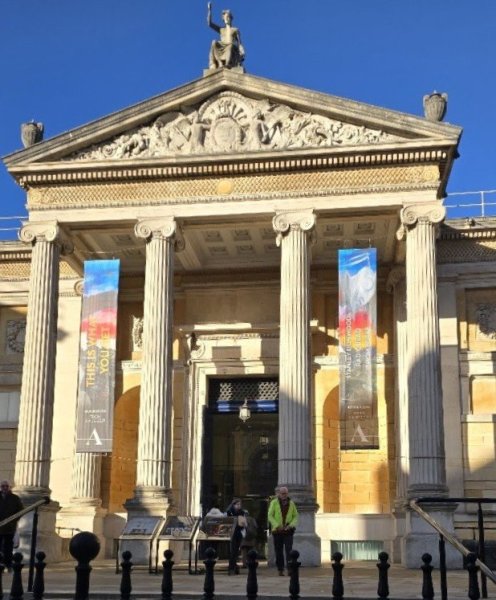
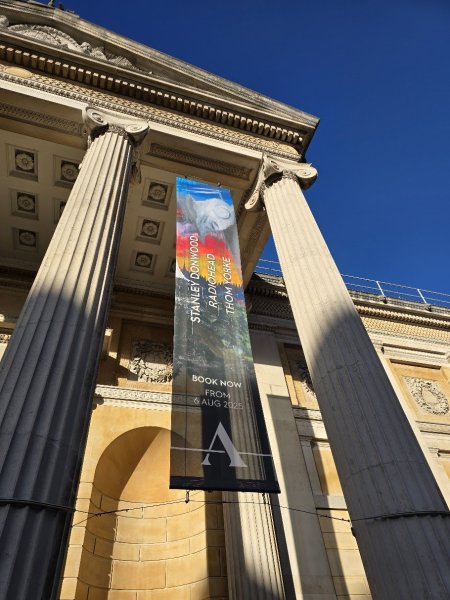
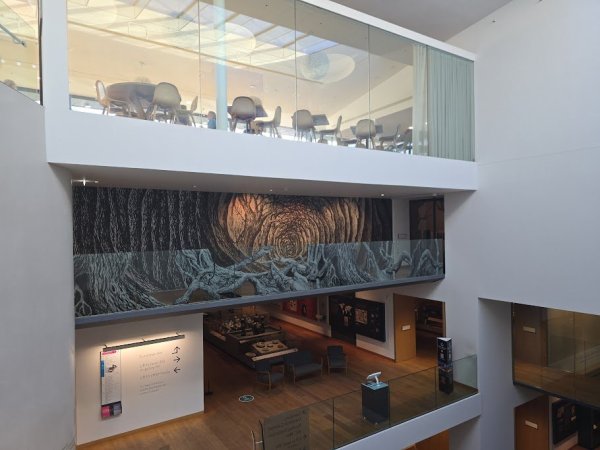
Stanley has made much of the big pillars out the front of the Ashmolean museum, and he’s not wrong. They are institutional and imposing. With both his and Thom’s names in BIG LETTERS on the banners — damn. It’s an odd moment of dissonance, standing there and feeling the weight of decades of work rendered so formally.
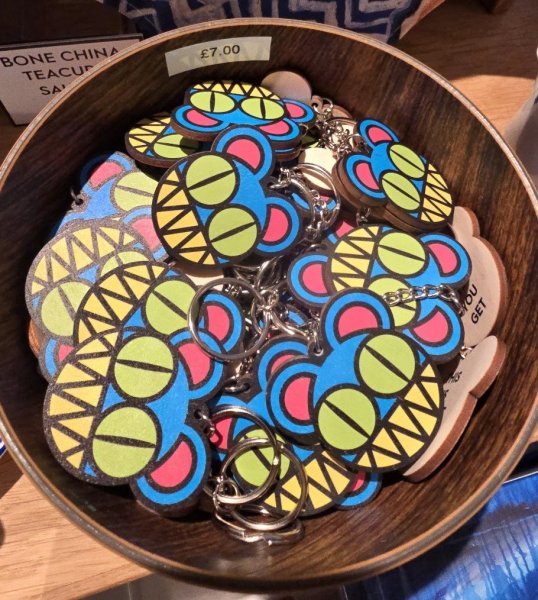
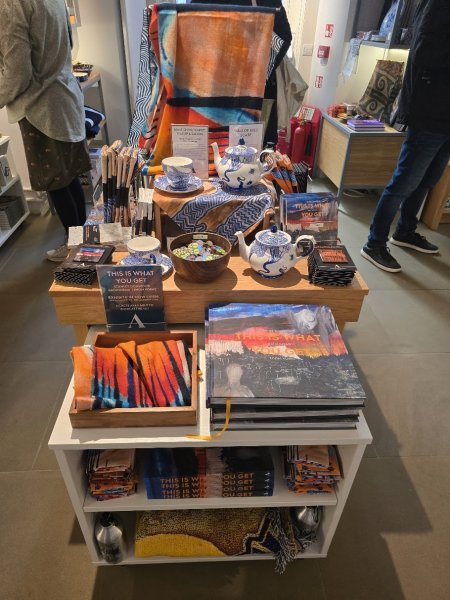
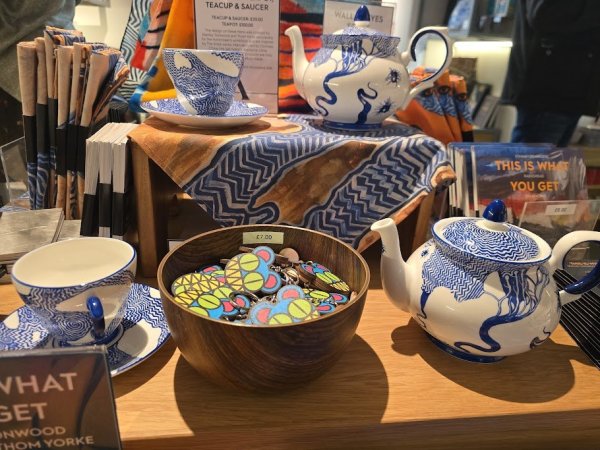
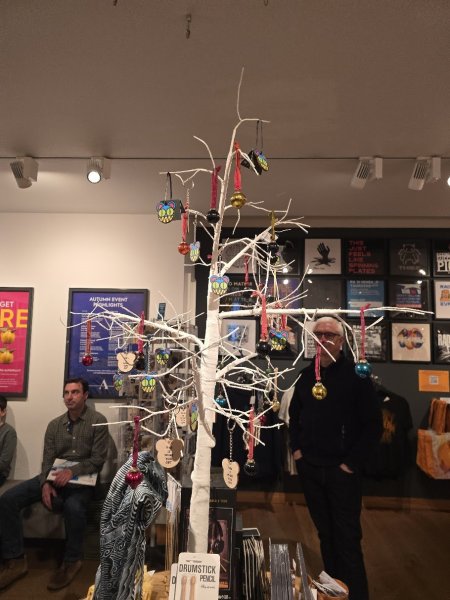
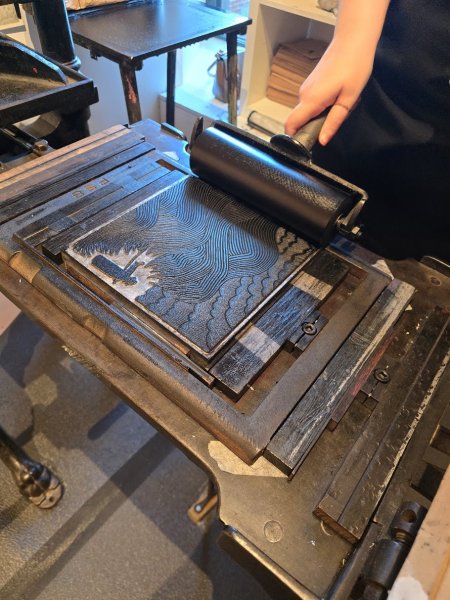
We enter and are immediately waylaid by the first gift shop. The first! There’s more than one. We are in trouble. I thought I’d been clever by buying and shipping most of the merch to Australia to save me lugging it around Europe. I did not anticipate the temptation of bowls of bear-shaped keyrings laid out like candy. Nor the giddy realisation that the volunteer running the DIY printing press was in residence, and that the print of the day was the iconic Eraser cover. I paid a few quid and operated the thing, pulling across and then down as instructed. I came away with a lot of ink on my hands, which was thrillingly and messily immersive. There is something deeply satisfying about physically operating this machinery and seeing the mark you’ve made upon a blank bit of paper.
There are others milling about with the same intent awe as me. Everyone here likes Radiohead. That’s not an environmental constant I’ve ever inhabited before outside of an actual show. Here, our shared inner world has taken on physical form.
My ticket is scanned by a very polite older lady who looks like she knows a great deal about art, though perhaps less about the intensity of this crowd. Her gentle bemusement suggests she’s seen a lot over the past few months. She smiles and hands me headphones.
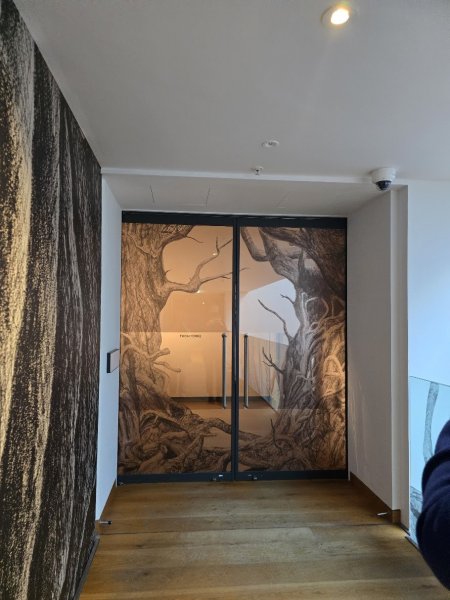
We walk along a corridor — a passage to another realm — and pass through glass doors decorated with Donwood and Yorke’s dark, unsettling woods. An angular black shadow-thing watches from a window. I’m in its world now.
The audio tour begins. Adam Buxton makes this strange landscape startlingly accessible, providing context and backstory in a patient, steady tone laced with dry humour that has me laughing out loud as I wander.
There’s a careful structure to how everything is laid out. With 180 objects to observe, it could easily overwhelm, but instead each period of their thirty-year collaboration has been given its own home. Quotes on the walls offer context and clues. The exhibition moves album by album, grounding each era in prints, notebooks, and ephemera.
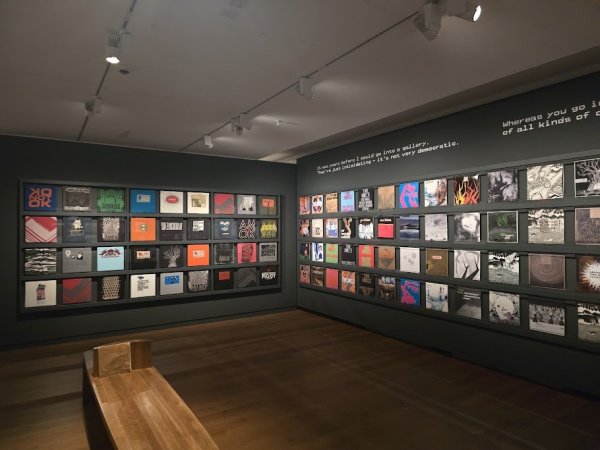
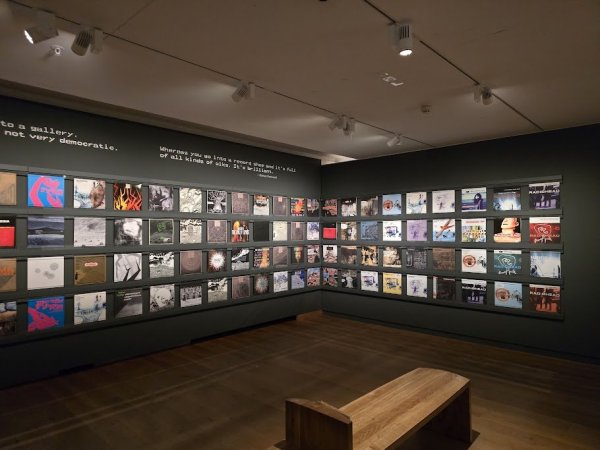
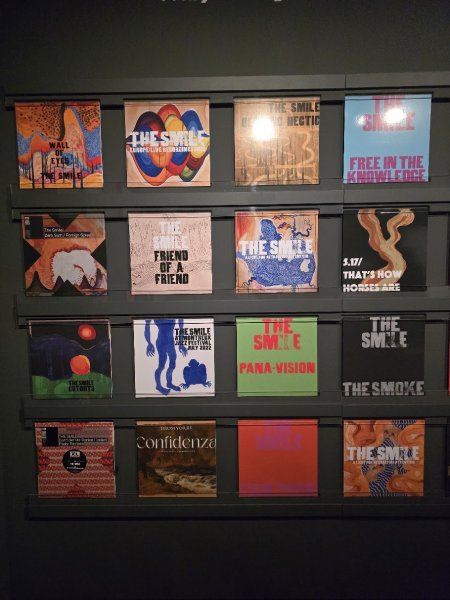
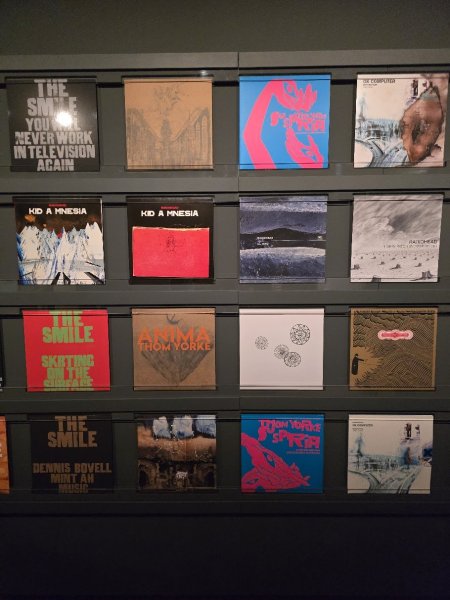
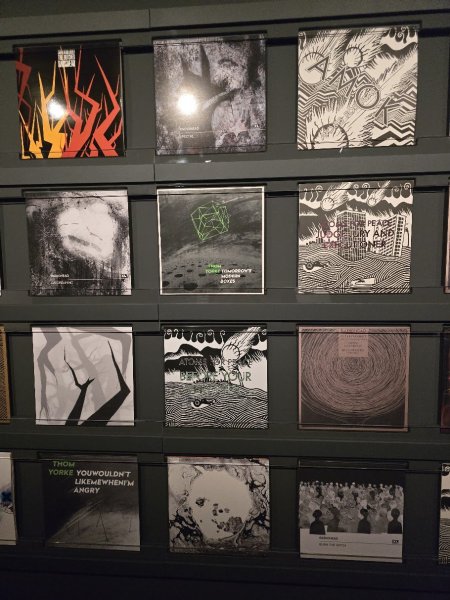
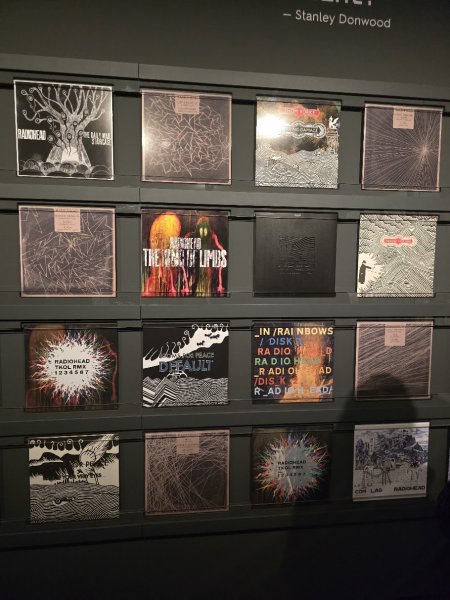
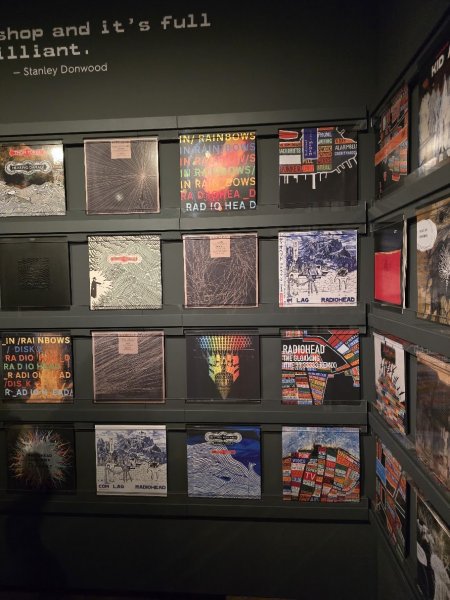
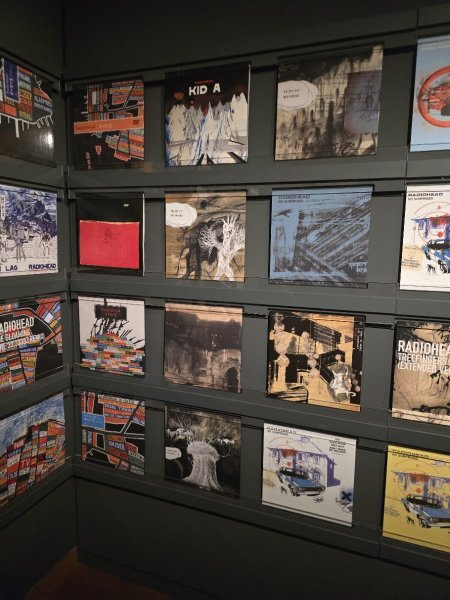
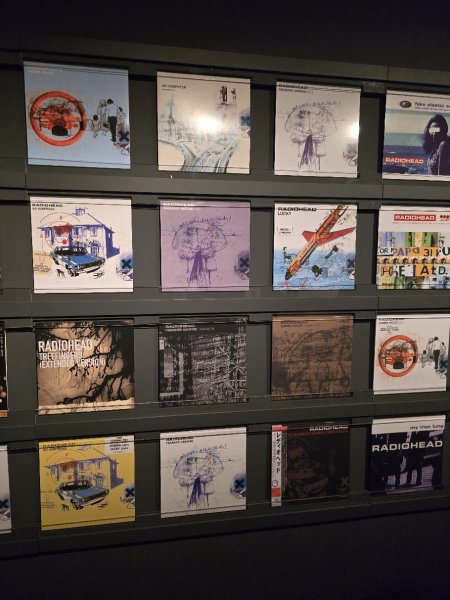
The first thing we come to is overwhelming in its own way: a wall of Thom’s records. Radiohead, solo work, all of it. This isn’t even complete. A lifetime of art and music. I’ve often said that one reason I collect vinyl is how easily you can acquire incredible visual art, that would otherwise cost a fortune. There’s a quote on the wall here about record stores that echoes that. ‘A democratic gallery’. Neat.
Somewhat chronologically, we move into The Bends era. We peer down at a fax machine and its accompanying ghosts. Notebooks sit open behind glass, early notes and lyrics capturing a naked moment of creation. These communications between Thom and Stanley are the genesis of entire worlds. One fax in particular stops me. Sent in Thom’s scrawl on hotel stationery, as if by a character in a Bond film, it crackles with playful madness. There is a sense of openness in this exchange, not just in allowing us this glimpse, but in the way ideas are shared and shaped between them. These two artists seem like opposites, chaos and order, and yet the trust between them is unmistakable. There’s a quality here, too, of being made before self-consciousness set in, before the adult brain kicks in and starts reframing and building barriers. It feels exposed, unguarded.
It would be easy to spend hours just reading these notebooks alone, but I’m aware there’s a train home to catch.
Partway through the exhibition, there’s a dark turn into a small enclosed space, screening a loop of what can only really be described as Radiohead’s early-2000s visual language. It’s difficult to recount afterwards, in the way dreams are difficult to recount. Flashes of shadowy figures, drifting forms, a sense of unease without narrative. I stand with my back to the wall alongside a few others as the loop completes, and when it ends I have to shake my head slightly, as if to dislodge whatever unknowable thing it’s just placed there. Weird.
Stepping back out into the bright white of the next room, I catch sight of the others doing the same — blinking, re-orienting, quietly coming back to themselves. I feel as though I’ve crossed a threshold, and looking up, my breath catches.
Arranged on the wall to my left are the original Kid A paintings. Their presence in the room is enormous.
Moving closer, I can see the layers — paint built up and scraped back, figures partially buried, details revealed only if you know to look. I’ve seen some of these before, years ago on some forgotten corner of radiohead.com, saved to my hard-drive for later pondering. Getting up close to them where I can see the edges of the paint is surreal. Words are carved and scratched out, painted over and revealed. There’s an endless, restless covering and uncovering. The longer I look for details, the more I find.
I’ve actually done this. I’ve come all this way. I’ve flown across the planet to stand in this room, right here, with the original Kid A paintings. After decades with this art in two dimensions, seeing it in three feels like stepping out of imagination and into something solid.
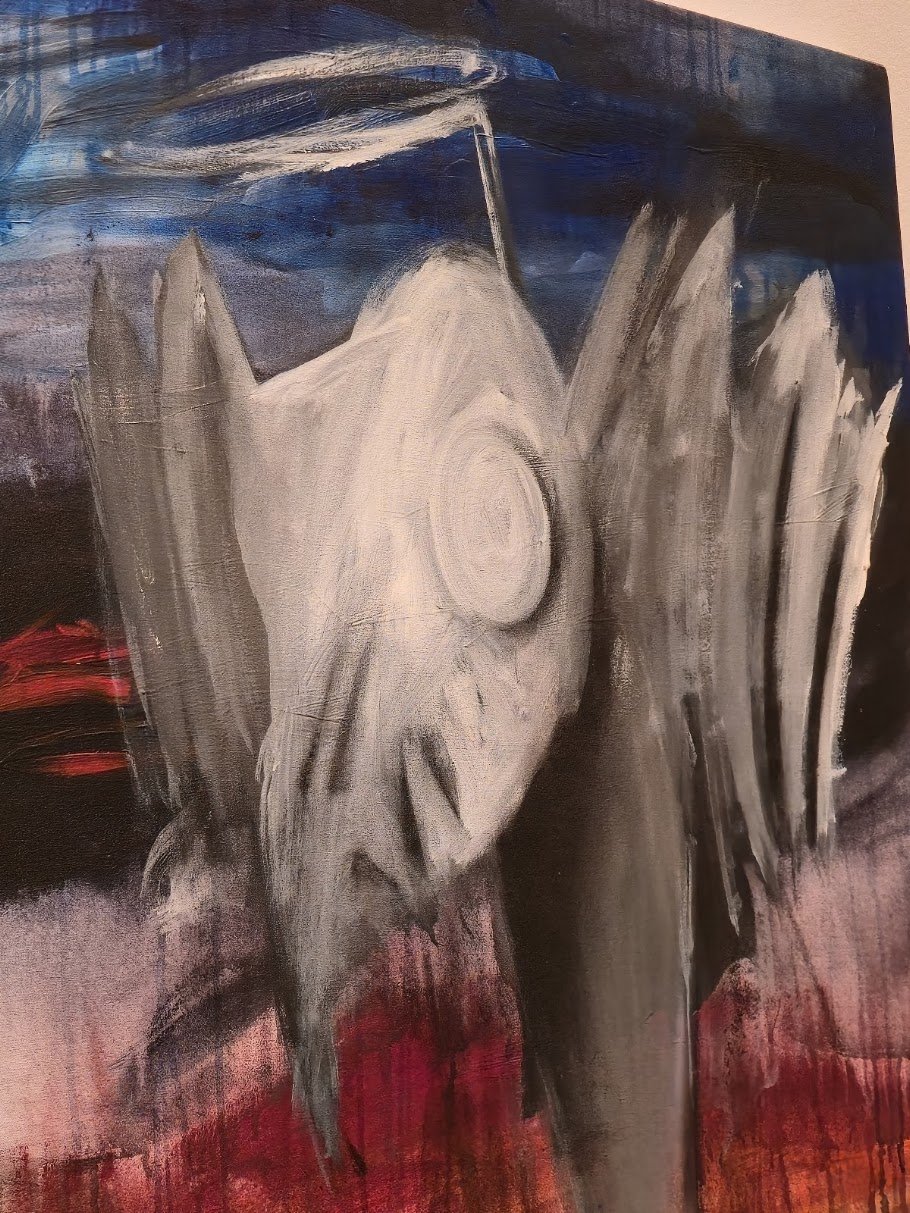
Get Out Before Saturday. This one is featured on the exhibition’s poster and it’s my favourite by far. I’m not sure why. It’s bleak and foreboding, with a grey looming threat from above and a figure paralysed below, alone, as if watching the world unravel. It’s sombre, yet the heavy sky is a vivid orange and blue, and there’s those layers covered and uncovered in the dirty snow. It’s a warning, but I want to stay and see. What is that big otherworldly thing in the top right? I think it’s a ghost-angel-alien. My friend thinks it looks like a gasmask horror, and the whole scene below is reminiscent of World War II. I’m not so sure. It’s certainly full of anxious drama, whatever it is. What are we getting away from? What’s happening below? What’s coming on Saturday? Why is that figure just standing, observing it all, and not running?
I spend a long time in that room looking up at that painting, trying to work that out.
---
After, we retrace our steps back to the train station. Dusk casts magnetic shadows over the town, ivy creeping along stone walls, bare branches stark against the darkening sky, twisty streets leading deeper in. I realise that inside the exhibition I’d entirely forgotten I was in Oxford. I was somewhere else. It’s jarring being back out here in the reality, and on the other side of all that art. I’m caught up in the way light glows over the water, how quiet everything feels, how the sky presses in overhead like it’s closing up for the night.
As I walk, it all plays back. The fragmentary digital panic of OK Computer. The bold, confrontational glare of Hail to the Thief. The uneasy bleakness of Tomorrow’s Modern Boxes. In Rainbows is an explosion of warmth in the void, where A Moon Shaped Pool softly implodes in black and white. They are not opposites, just entirely separate moods. I stepped through them like a time traveller, inhabiting each briefly before moving on. Though there is no music playing, the songs were clearly heard.
What stayed with me most were the notebooks. Page after page of early lyrics, fragments, drawings, worries, half-formed ideas. The building blocks of everything that followed. I have notebooks like this at home that I’ve kept for years. I’d never show them to anyone. They’re strange and deeply personal. Yet Thom and Stanley’s are here, held open behind glass.
Everyone who walks through is pulled toward them. There’s a strong urge to turn the pages, to see how far it goes, but over the years as fans, we’ve learned to take what we’re given. This is what you get. And we are grateful.
ʕⱷⱷʔ
This is a digital excerpt from ALL THESE WEIRD CREATURES: A Radiohead Fanzine, which you can get print copies of while they last here
Images
-
 2
2
Recommended Comments